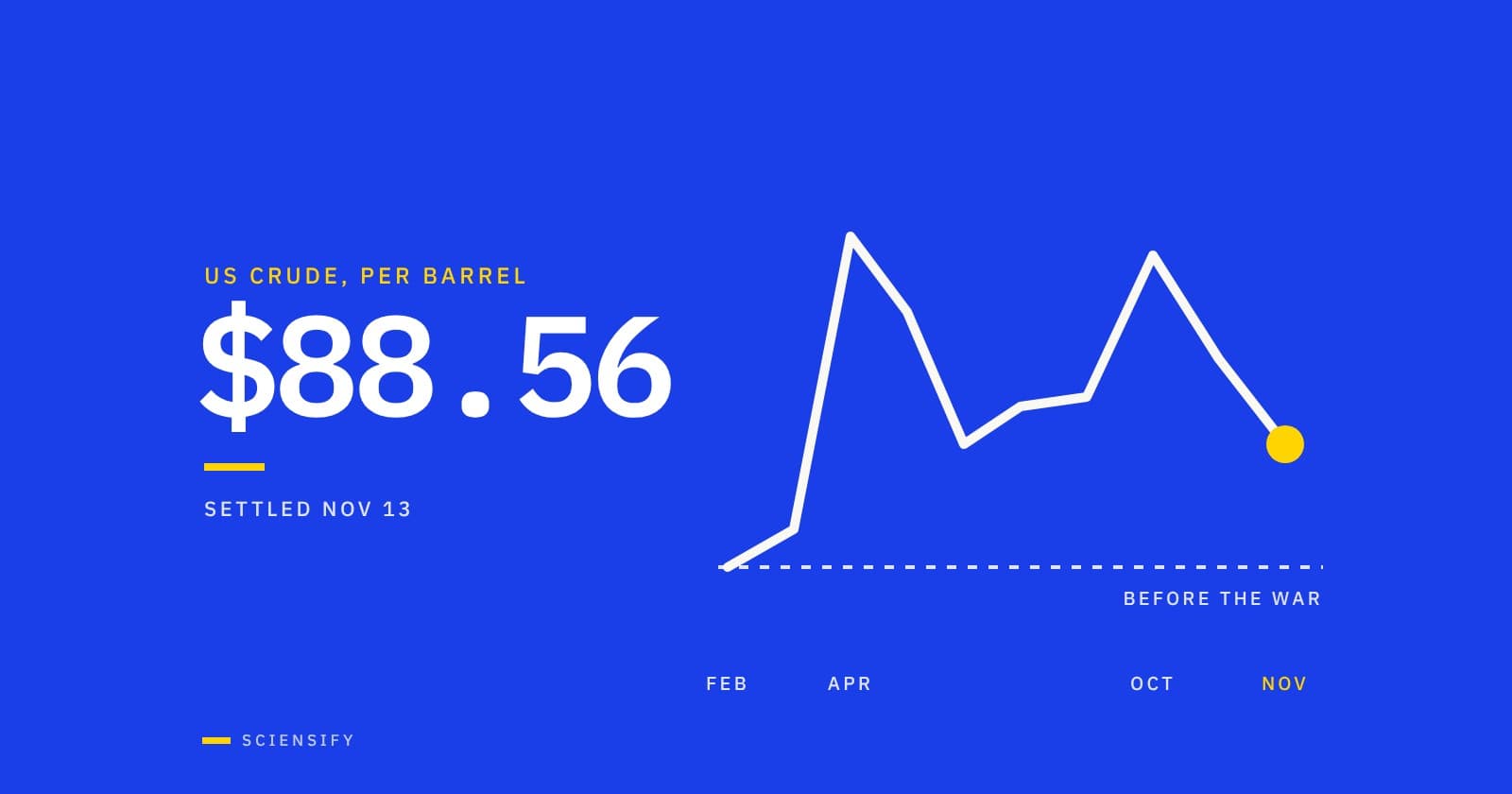
Oil is high, but it is no longer climbing. US crude, known as West Texas Intermediate or WTI, settled at $88.56 a barrel on Friday, November 13, and the global benchmark Brent settled at $95.84, CNBC reported. That is far below the wartime highs of April and October, after hopes for an end to the Iran war and a recovery in Gulf exports pushed prices down, but it is still well above the roughly $72 Brent price just before the war began. For Americans, that means gasoline has dropped below $4 a gallon but still costs more than a year ago, and energy remains one of the inputs the Federal Reserve is watching ahead of its December meeting.
Where oil prices are now
A barrel is 42 gallons. WTI is the main US price; Brent, based on North Sea oil, is the main international price.
- WTI: $88.56 at the November 13 settlement (CNBC).
- Brent: $95.84 at the same settlement. CNBC noted that reports differ by a few cents on recent closes.
- The last two weeks: Brent fell 16% and WTI 13% in the week after the November 3 midterm elections, then each lost about 2.5% more in the week ending November 13 (CNBC). Bloomberg called the first of those its biggest weekly drop since 2020.
- A few weeks ago: On October 23, Brent settled at $116.72, its highest close since April 29 (CNBC).
- Before the war: Brent was around $72 on February 27, before nearly reaching $120 at its spring peak, according to a CNBC timeline.
So the answer to "why is oil high?" has two parts: the war pushed prices up sharply this year, and the recent fall has only taken back part of that rise.
What is driving the price
The war involving Iran and the Strait of Hormuz. The Strait of Hormuz is a narrow sea lane off Iran that normally carries around a fifth of the world's oil and natural gas supplies. In October, CNBC reported that the strait was effectively shut as US and Iran talks stalled, that investors expected the US to resume strikes on Iran, and that Iran allied Houthi militants in Yemen were striking Saudi Arabia. Ships are moving again in larger numbers: on November 10, Bloomberg reported that Saudi Arabia's main tanker company was sending vessels through the strait in coordination with the US military. But attacks on tankers leaving the Gulf and Houthi strikes on Saudi infrastructure continued in the week ending November 13, CNBC reported.
The US blockade and sanctions on Iran. A US Navy blockade has sharply cut Iran's own oil exports, CNBC reported in August, as the administration turned to economic pressure. On November 12, President Trump said a deal with Iran was not needed to end the war, which CNBC read as a sign he will keep the blockade and sanctions in place. CNBC's headline quoted him: "We've got their Strait."
Hopes for peace after the midterms. CNBC reported that the midterm results raised hopes that the war could end quickly. On November 10, Brent briefly dipped below $90 for the first time since August on hopes about Iran. Our midterms explainer covers the election itself.
OPEC+ is holding steady. OPEC+ is the group of oil exporters led by Saudi Arabia and Russia. On October 4, seven core members agreed to keep November output targets unchanged, and on November 1 they kept December levels unchanged as well. The group's next meeting is set for November 29.
More supply, fuller tanks. The International Energy Agency (IEA), which advises wealthy countries on energy, said on November 13 that world oil supply has moved ahead of demand for the first time since the war began. In its November Oil Market Report, it said October supply rose by 2.3 million barrels a day as Gulf exports recovered, and that global inventories rose by 52 million barrels, the first increase since June. Gulf exports, excluding Oman, were still 26% below prewar levels. In the US, the Energy Information Administration (EIA) said commercial crude stocks rose by about 4.7 million barrels in the week ending November 6, to roughly 414 million barrels, while US output was about 14 million barrels a day, according to Rigzone's summary of EIA data.
A short timeline
| Date | Event |
|---|---|
| February 27 | Brent around $72, before the war (CNBC) |
| April | Dated Brent, a physical oil price, hits a record high (Bloomberg) |
| April 30 | Brent futures briefly touch $126.41, a four year high (CNN) |
| August | US Navy blockade cuts Iran's oil exports (CNBC) |
| October 4 | OPEC+ holds November output steady (CNBC) |
| October 23 | Brent settles at $116.72 (CNBC) |
| November 1 | OPEC+ holds December output steady (OPEC) |
| November 3 to 6 | Midterms; Brent falls 16% on the week (CNBC) |
| November 10 | Brent briefly dips below $90 (CNBC) |
| November 13 | IEA says supply has overtaken demand; Brent settles at $95.84 |
One point of confusion: different "Brent" prices are reported. The IEA said North Sea Dated crude, a price for physical cargoes, fell 32% from a high of $136 in early October to $93 when its report was written (IEA). Brent futures, the contracts most news reports quote, peaked lower in October, at $116.72. Both are accurate; they measure different things.
What it means for gas prices
The national average for regular gasoline fell below $4 a gallon on November 12 for the first time since July, to about $3.90, AAA said. AAA credited lower crude prices and the seasonal switch to cheaper winter blend fuel. By Saturday, November 14, the average was $3.84, down from $4.33 a month earlier, Yahoo Finance reported.
That is still more than drivers paid a year ago. AAA put the gap at 76 cents a gallon. The government's inflation data show the same thing: the gasoline index was up 37.4% from a year earlier in October, before seasonal adjustment (BLS).
The EIA expects regular gasoline to average $3.89 a gallon for all of 2026 and $3.73 in 2027, according to its November Short-Term Energy Outlook.
What it means for inflation and the Fed
Energy feeds into inflation directly, through what people pay at the pump and for heating, and indirectly, through shipping and airfares. In October, the Consumer Price Index rose 0.4% and the index excluding food and energy rose 0.3%, the Bureau of Labor Statistics said. The energy index rose 0.7% after jumping 5.2% in September, and gasoline rose 1.0% after a 9.1% jump in September, both seasonally adjusted. BLS did not publish a 12 month change for the overall energy index for October, because October 2025 data was not collected during last year's government shutdown.
Lower pump prices in November could ease the energy part of the next report, but that report has not been released. We explain how the hot October numbers fed into expectations for a December rate hike in our Fed explainer.
How stocks have reacted
Energy stocks rose with oil, then fell with it. Exxon Mobil was up 38% in 2026 and Chevron 39% as of early November, Yahoo Finance reported. The same report said Brent fell more than 8% on November 4 and Exxon fell 4.6% that day. In the week after the election, the S&P 500 energy sector was heading for a loss of nearly 12% and was the worst of the index's 11 sectors, CNBC reported. On Monday, November 9, energy was the only sector falling in afternoon trading, after a one week loss of more than 8% (CNBC).
Airlines moved the other way. Fuel is one of an airline's biggest costs, so airline shares often rise when oil falls. On one day of falling oil and peace talk hopes, JetBlue rose 11%, United 6% and American 5%, Yahoo Finance reported.
The wider market had other worries. The biggest swings in US stocks this month came from AI and technology shares, not oil. See our explainer on the November 5 AI sell-off.
What forecasters expect
- IEA: Expects supply to exceed demand by 1.7 million barrels a day in the fourth quarter of 2026, with a larger surplus in 2027. It expects world oil demand to fall by 2.7 million barrels a day in 2026 to 102.3 million, and called diesel shortages the market's "overriding concern" (IEA, BNN Bloomberg).
- EIA: In its November 10 outlook, sees Brent averaging about $97 in 2026 and $86 in 2027, and holding near $100 for the rest of 2026 because of continued supply disruptions (EIA). Brent was already below that level on November 13.
- Goldman Sachs: Raised its 2027 Brent forecast to $88 from $80, citing an allowance for supply disruptions from the Middle East and the war in Ukraine, Yahoo Finance reported.
- JPMorgan: Had a much lower 2027 estimate of $64 in a June note, on expectations of a surplus, according to Yahoo Finance. We did not find a more recent JPMorgan figure.
The roughly $24 gap between those two banks shows how uncertain the outlook is.
What would change the picture
- A deal, or no deal. A lasting agreement to end the war could push prices lower; renewed strikes could push them higher. On November 12, Trump said a deal was not needed (CNBC).
- Shipping attacks. The IEA warned that continued attacks on shipping could derail the supply recovery.
- The blockade. Lifting it would let Iranian oil back onto the market. Trump has signaled he intends to keep it.
- OPEC+ on November 29. The group is scheduled to set policy for 2027 at its next meeting.
- US data. The next weekly EIA inventory report is expected on Wednesday, November 18.
What we know and what we do not know
What reports confirm: WTI settled at $88.56 and Brent at $95.84 on November 13 (CNBC). The AAA national gas average fell below $4 on November 12 (AAA). The IEA says the market has returned to surplus (IEA).
What is uncertain: Whether and when the war ends, how much traffic through the Strait of Hormuz will recover, and how forecasters will update. Reported casualties and damage from the war vary by source, and we do not repeat them here. Sciensify takes no side in the conflict.
Sources
- Oil prices post second straight weekly drop on signs of growing supply surplus
- Brent crude briefly dips below $90 for first time since August on Iran hopes
- Oil prices rise after Trump says no Iran deal needed: 'We've got their Strait'
- Oil Prices Extend Biggest Weekly Drop Since 2020 With Iran Talks in Focus
- Brent crude oil tops $116, a six-month high, as tensions swell in the Middle East
- A timeline of how the Iran war shook oil prices, and what comes next
- Oil briefly touches $126, its highest price in four years
- Dated Brent Oil Price Jumps to Highest Level on Record
- U.S. Navy blockade slashes Iran oil exports as Trump administration shifts to economic warfare
- Saudi Tanker Firm Sends Vessels Through Hormuz With US Military Coordination
- OPEC+ agrees to keep November oil output targets steady
- Press release, 1 November 2026
- Oil Market Report, November 2026
- World oil market is returning to surplus as Gulf exports recover, IEA says
- November 2026 Short-Term Energy Outlook
- USA Crude Oil Stocks Rise Almost 5MM Barrels Week on Week
- For the First Time Since July, National Average Drops Below $4
- Gas prices for 11/14/26: National average down nearly 50 cents in last month
- Consumer Price Index News Release, October 2026
- Table 2. Consumer Price Index for All Urban Consumers, by detailed expenditure category, October 2026
- ExxonMobil Is Up 38% in 2026 and Chevron Is Up 39%: Take Profits, or Hold On?
- Stock market news for Nov. 6, 2026
- Stock market news for Nov. 9, 2026
- JetBlue Soars 11%, United Rallies 6% as Oil Drops on Iran Peace Talk Hopes; American Airlines Gains 5%
- Goldman Sachs quietly resets oil price forecast for 2027
- JPMorgan resets oil price target for rest of 2026